
Spring classes started for me this morning with Protein Fabrication, which is (in laymen's terms) butchering meat. It's a bit of a suprise that I signed up to learn about breaking down meat seeing as five to seven years ago I did not eat red meat. It wasn't for ethical or health-related reasons; it just kind of grossed me out in its raw form. So slimy and rubbery. Plus my mom had a tendency to overcook. But these days, things are different. I don't eat much meat truly. I try to always have bacon on hand, but other than that, I only buy meat or poultry when I have something specific I want to make in mind. I've moved far away from being jittery with grease or skin, and I suspect this class will only move me even further.
We started out with pork. Simple stuff really. Although I now have a greater appreciation for the word "butcher" because I butchered my tenderloin, trying to remove the tough, inedible silverskin from it. It was a bit of a juicy mess. Removing the back fat from my pork chops did not go smoothly, but it was only day one, and I have never spent this much time with a piece of raw meat before.
We were assigned to do some readings, look up information on pork and to watch some videos posted on Chef Garvey's Web site. The series of videos on pork follows the piglet from pretty much whole hog (minus the innards) to portion-size cuts. Not going to lie, it was a little shocking at first. There was Drew, the class teacher's aid, with the pig pointing out the kill point in its throat and then, yes, sawing the head off. It ended somewhat dramatically with him snapping its neck. I'm not sure I'm up to that. I'm not even sure I'm up to jabbing a live lobster between the eyes to snuff out its life, but if I'm eating it, shouldn't I be able to kill it? Sebastian and Wilbur deserve a little more respect than what I give them, I think. Trussing a pork tenderloin ... that I can do. I'm already working out a plan involving a dry rub. Now all I need is a guinea pig or two--and not to cook although I have eaten guinea pig (tender dark meat, very tasty).
Wednesday, March 9, 2011


Monday, March 7, 2011
Amaretto Biscotti

Biscotti are like cookies for adults, to be dunked in coffee instead of milk. This version of biscotti isn't too hard at all, not that I mind much the crunch. Dunking still leaves little remnants in the cup, saved for the last slurp. I use amaretto liqueur instead of kirsch because it's cheaper, also it reminds me of my early days of drinking. At 21, amaretto sours were just about all my friends and I could handle. That and midori sour. Those were our "adult" drinks after the too-early days of drinking Smirnof Ice, yikes. Now amaretto's only use in my house is in baked goods. Maybe once I'm in my 30s I'll start using kirsch brandy and drinking whiskey with ice (that seems a long way off).
The recipe is easy with almost no cleanup. And these beauts are addicting.
Amaretto Biscotti: makes 18
1 cup sugar
1/2 cup butter, melted
3 tablespoons amaretto liqueur
1 teaspoon vanilla extract
2 teaspoons almond extract
3 eggs
1 cup almonds, toasted and chopped
2 1/2 cups flour
1 teaspoon baking powder
1/2 teaspoon salt
Preheat oven to 350. In a bowl, stir together sugar, butter, liqueur and extracts. Add the eggs and stir to combine. Add the almonds. Stir in the remaining dry ingredients until everything just comes together. Turn out on a baking sheet and mold into two logs that are eight to ten inches long, three inches wide and one or so inches thick. Bake for 30 minutes. Remove and let cool a bit. Slice into one-inch thick pieces and bake again for 20 to 25 minutes.
Wednesday, March 2, 2011
Here's To Breaking Things

I have a tendency for the dramatic (if you haven’t noticed). Every once in a while, the bike I’m riding breaks down (in this case literally; I broke the wheel of my bike) and I just throw it away and start again on a brand new bike and on a brand new trail. I went on a diet five years ago when I was about 20 to 30 pounds heavier (it’s hard to tell because I didn’t weigh myself much). Diets aren’t successful for most people, but for someone with my personality type (ENFJ, if you must know), they are fantastic. It’s invigorating to throw out old habits and start all over again. Of course, I gave it up after a couple months, but that was enough to change my life. New Year’s resolutions are great for me. I’m simultaneously self-analytical (to a fault) and persistent, which means I'm constantly trying to better myself in a one-step process. So when things started to sort of unceremoniously unravel in the past couple weeks, I was ready with a plan. Or perhaps the plan was ready for me.
I got fired. Well, I should (less dramatically) say that the steady contributing editor position I held at a newsweekly was given to somebody else (in the sales department, I might add), but they still want me to write for them. I found out and was a little crushed. I loved parts of that job. A lot. I drove 12 hours round-trip in winter weather for a story about George Paul’s artisanal vinegar, I get to hear about people’s lives and passions told through their food, and it sort of feels like that was shat on. But in the same vein, I understand why, and a week or so away from the let down, I’m a little relieved to go home from eight (or so) hours at work or school and not have to churn out a story or interview someone. But it feels devastating in a way because writing is what I love, it’s what I do, it’s what I want to do, and a door closed feels a little like all doors closed.
My bike broke, I bent a wheel on my car running over a pothole, I let go of a friendship and nearly lost another. Writing about the loss of friends at the end of statement like that makes it seem like no big deal, like they’re as easy to fix as a bent tire rim. I wish it were. With letting go, I hope that means I can come back. I do, I really do. Many times, I want to call or email and say that I take it all back and that I can get through on a bent wheel until the entire thing just breaks or maybe the road we’re on is already bumpy and a friendship with a bunch of dents in it doesn’t matter because it wasn’t going to be a smooth ride anyway. I need more time, time to fix my wheel. And then there’s the other friendship, the one nearly lost, which in the end exposed me to be a complete crazy person. I’m not the only one who acts completely irrational in this world. In fact, I would defend my actions (most of them) and am grateful that my friend was willing to hash everything out.
Then there’s dating. I am complete and total failure at dating. No one aces it, I know. And if you do, keep it to yourself thank you. My mom said it is supposed to be fun (is it?). For me, dating has never been fun. It occurred to me, well it occurred to my mom and sister who then told me, that I’m trying too hard and I should just give it up for a while. So I did. I am doing the cliché thing that everyone says they do right before they meet somone (gag me please all you people with your rose-colored hind-sight): I am giving up dating for something like a Lenten period. Forty days of not worrying about meeting a guy here or flirting with someone there or not making a fool of myself in this or that situation. The first thing I did was to give up Facebook. I have spent an entire week away from Facebook with barely a temptation to return.
On my first day off after the quarter ended, I fixed my car and set to work on fixing myself. Self-help, as far as I can tell—and I am no expert—involves quite a bit of journaling, venting to all your friends and doing the things that you love. One of the things I love is, as you may guess, cooking.
I finally learned something useful from my soup and sauce cookery class, and that is integral sauce made from pan sucs. For this sauce, I seared the outside of a whole chicken (divided into legs, thighs and breasts) to crisp up the skin and baked it at 350 degrees for a little less than an hour, leaving all those beautiful juices in the bottom of the pan. I removed the chicken once cooked and set to work on the sauce by deglazing the pan with a bit of dry white wine. I poured in some hot chicken stock and added beurre manie, which is equal parts flour and butter kneaded to a smooth consistency (about one-fourth a cup will do for one chicken). I brought the sauce to a boil to cook out the flour flavor and then served it sprinkled with fresh tarragon and alongside new potatoes and green beans. Ice cream for dessert and Nebraska Brewing Co. beer. It was a good meal in my almost excellent life.

Saturday, February 19, 2011
They'll Probably Serve This in Heaven

Familiar knowing. I think "to know" is better said in French or Spanish, languages that have two words for "to know." Connaitre (or conocer) means to know a person and to me evokes this feeling of having met someone, talked to them, been in their presence. Whereas savoir or saber is to know about something, to have a well of information. Perhaps I'm being cavalier with my translations, but when I think if savoir, I think of reading. And when I think of connaitre, I think of doing. I would like to connaitre pastry cream. I'd like to connaitre it so well that I can transform it into other things. Something with a different flavor perhaps. Strawberry, saffron, lavender. I'm not there yet with chocolate eclairs. These are just plain ol' pate a choux with vanilla pastry cream and straight-up chocolate ganache.

Pate a Choux: yields 12
4 ounces butter
8 fluid ounces water
5 ounces flour
3 to 5 eggs
Preheat the oven to 400. In a small sauce pan, bring the butter and water to a boil. Stir in the flour with a whisk, let the mixture get pretty dry with the excess water evaporating out. Transfer the mixture to the bowl of a standing mixer. Let it cool down a bit, until the bowl is just warm to the touch. Add the eggs one at a time being sure they fully incorporate each time, until the consistency is pasty and not too runny. You'll be pipping it out, so it has to hold its shape. Using a pastry bag, pipe into logs or rounds (those can be cream puffs) and bake at 400 for 15 minutes and then reduce heat to 350 and bake until they're dried out and nice and brown.
Pastry Cream:
12 fluid ounces milk
4 fluid ounces cream
3 3/4 ounce sugar
5 egg yolks
1 ounce cornstarch
In a heavy saucepan, bring the milk and cream up to a boil being careful not to scorch it. Meanwhile, in a separate bowl, whisk together eggs, sugar and cornstarch. Once the milk boils, carefully and slowly pour one-third of it into the eggs mixture to temper it while whisking. Once the eggs have warmed slightly, pour it all into the saucepan with the milk and return to heat. Bring to a light boil and continue whisking (do not stop whisking) until the mixture thickens up quite a bit. Remove from heat and refrigerate.
Chocolate Ganache:
1 part chocolate
1 part whipping cream
a couple tablespoons butter
Melt the chocolate in a double boiler. Add the cream slowly until you reach a desired consistency, which should take no more than the same amount of chocolate you used. Finish by melting in some butter. Pour over cakes or pastries once it has cooled to 90 to 100 degrees, which is barely lukewarm.

Sunday, February 13, 2011
At Last

With two sticks plus a tablespoon of butter blended (by hand--and this may be the key), I just knew I could get the flakiness I wanted. The outer edges of the currant scones caramelized to a crusty golden brown while the inside is soft like a buttermilk biscuit. Biting into them after 35 minutes in the oven at 400 wasn't the hallelujah moment I expected to have once I accomplished what feels like the goal of this blog. I tore off a piece, popped it into my mouth, and thought, "Yeah, this is it. I think this is the one." Like the rocky turning of winter to spring, or the slow realization of sweet, simple love: Yes, this is right. Yesterday was the pits, but today I can make scones and spring will come.
My sister and I were sitting at the bar of Senor Matias earlier this week, before the weather changed from 4 degrees to 54. We were both sipping on margaritas counting our woos on both hands, both of us down in the dumps. I kept saying, between bouts of lying my head on the bar, "It's going to get better once it's spring. The sun is going to come out and the snow will melt and it will be better." All said more as a reassurance to us both than in a real sense of hope. I swear that everyone I know is just aching for the long days of summer. I can think of so many people emerging slowly and limping from the great cloud that is winter in a temperate climate zone. It's so funny to talk of the weather, but do you realize what an impact the environment has on people? Of course we all talk about it. I'll celebrate 54 degrees on a Saturday in Feburary with scones, perhaps I'll commemorate 68 degrees coming up this Thursday (!) with a cake.

3/4 cup zante currants
4 3/4 cups flour
1 tablespoon baking powder
3/4 teaspoon baking soda
1/2 cup sugar
1 1/4 teaspoon salt
1 cup and 1 tablespoon cold butter
1 1/2 cups buttermilk
1 teaspoon lemon zest
top with melted butter and large-grain sugar crystals
Preheat oven to 400. Soak the currants in hot water for 10 minutes to plump up. Sift flour, baking powder and baking soda into a large mixing bowl. Add the sugar and salt and stir to combine. Cut the cold butter into cubes. Cut butter into the flour with your hands. Before my baking basics class, I used a pastry blender, but my teacher says she likes to get in and touch everything she bakes. I love the philosophy. Get to know it by feeling it, sort of thing. It works well in this case. Blend the butter into the flour until the mixtures forms pea-size crumbs. Pour in the buttermilk, lemon zest and currants. Stir with a wooden spoon to blend. Add more buttermilk if the mixture is too dry, which mine was but that's probably because it's winter and there's no moisture in the air. Once the dough has come together, turn out on a heavily floured work surface. Form into a log that is 18-inches by five- and is two inches thick. Cut out scones with a chef's knife. Arrange on baking sheet. Brush scones with melted butter and sprinkle with sugar. Bake for 25 to 30 minutes. I actually ended up needing to bake it for 35 minutes. But bake until the top is nice and golden brown.
Saturday, February 5, 2011
Drunken and Sunken

My sister gave me a cookbook from the Humingbird Bakery in London, which interestingly enough sells American baked goods specifically cupcakes. I forget about all the great sweets Americans bring to the global table: brownies, cookies, pies, a sweet and moist cake and cupcakes. My problem is that I often come to things like brownies, cookies and cakes and think they're too boring or too sweet, which they often are, so I want to mess with them. So I do things like replace the milk with whiskey, which frankly should be a lifelong rule of thumb, and add instant coffee. Using my now somewhat scientific knowledge of the baking process, I figured the moisture with the milk and with the whisky would equal out, what doesn't even out is the fat content--there being none in whiskey. So batch one of the drunken mocha cupcakes was a flop, literally.
I think the friends I rounded up to watch movies on the snow day would have been happy with the drunken-sunken cupcakes, but pulling what little bit of a perfectionist I have lying around deep down inside, I made another batch, which didn't turn out perfect (the recipe was listed in weight and I lost my scale, so measuring was a touch inaccurate) but it was acceptable. Someday I'll find a good American chocolate cupcake recipe, and when I do, I'll share it with you.

Monday, January 24, 2011
This is Hollandaise Sauce

It was something like two and half year's ago that I first made Hollandaise, botched it and wrote my first blog post about it. I over-cooked it, something I now know I could have fixed with a little hot water or another egg. But in a way it started me on a path of discovery involving food, a lot of mistakes and even more reflection. It was also the trajectory that landed me somewhere in a field of contentedness. Before Food Eaten I was up and down, all over the place really. Sky high one day, imagining myself as a young Senator fielding calls for outings with attractive celebrities (you think I'm kidding?), and then turning into a bumbering ball of tears the next day struggling with a weekly existential crisis. I won't say it was all food that led to this so-called healing. It was friends, family, vitamin B supplements (a miracle if you ask me, run to your nearest drug store), the realization that yes, I was at least somewhat attractive to the opposite sex (that was nice), plus the faith I tether my life to--if somewhat loosely tied. That's not to say I haven't run into the occasional full blown meltdown or the despressing string of a month or so. But it has gotten better, and so has my cooking.
There's this knowing that made the difference. For the longest time I had an unreasonable fear of pie crusts. I screwed them up a few times, one time getting the dough stuck in a too-small food processor and then trying to transform the mess into shortbread cookies. But this one time, I followed some detailed instructions for pate sucree and voila, perfect tart dough. Now I can't get enough. I will never mess up tart dough again because I know what it's supposed to feel like, look like, taste like. The same goes for this Hollandaise. You whisk two eggs with some cool water in a double boiler until the whisk slows down across the yellow sauce creates streaks. Removed from heat, you pour in seven ounces of clarified butter, slowly while still whisking until you don't think the sauce can take any more. And then comes the salt, enough lemon juice to flavor it and some cayenne pepper. In this way, I learned to walk, talk, kiss, write, love.

Wednesday, January 19, 2011
Brussels Sprouts Are Good
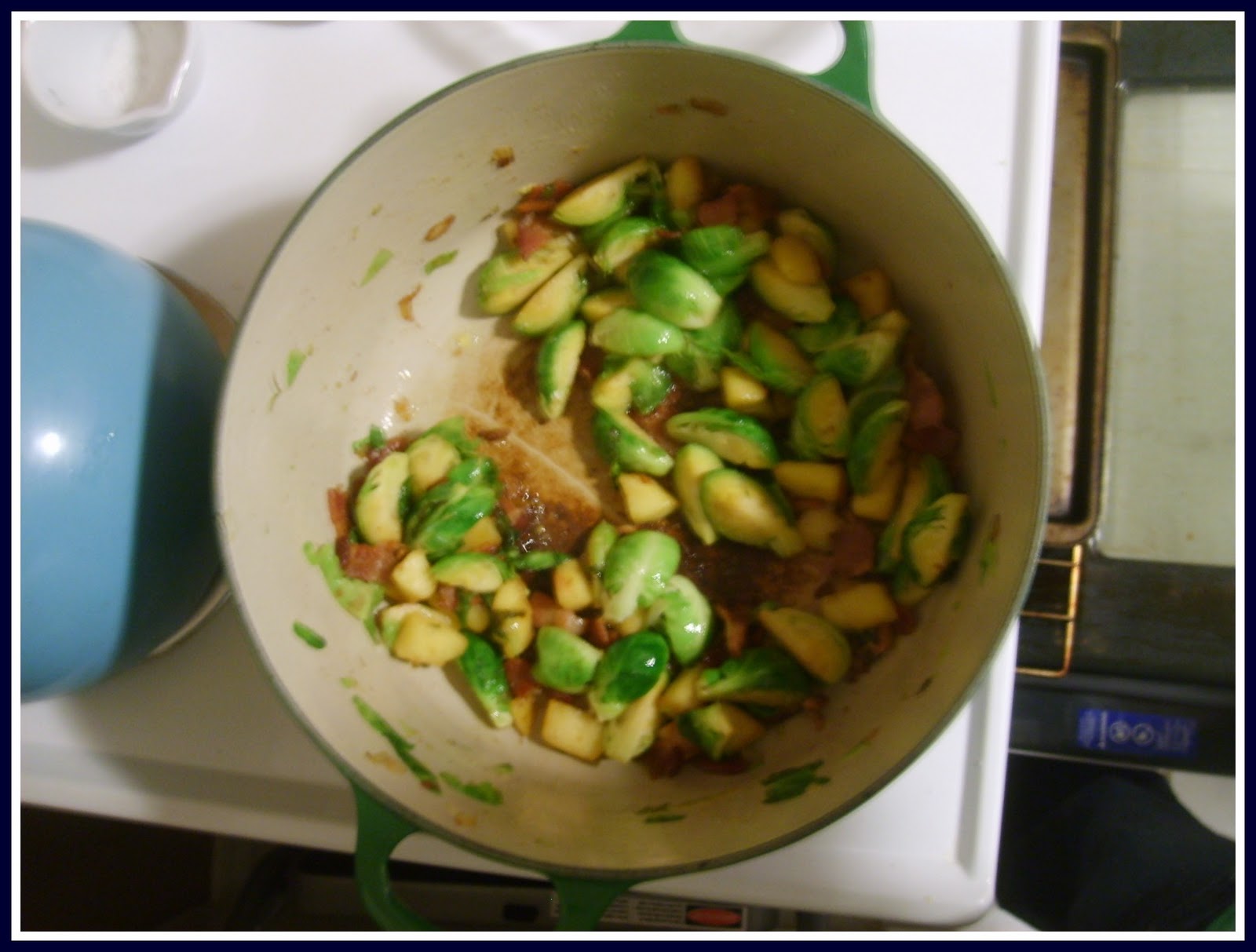
Those cabbages in miniature soaked up just the right amount of grease, which slipped part of the way between the leaves like legs between sheets and lent a sultry edge to the greens. They were still crunchy after a good saute in the Dutch oven, taken off the heat just shy of the point at which they turn into the vegetable people loathe, bitter and slimy. You have to take care of these brassicas, watching not to overcook. The apple brought out the sweetness in the bacon, while the vinegar (the finest brand I've ever tasted) cut through the grease with a zing. I was popping down Brussels sprouts as if it were candy.

Sauteed Brussels sprouts with bacon and apples: serves 4
1/2 pound bacon, diced
1 pound Brussels sprouts, quartered
1 apple, peeled and diced
salt and pepper
apple cider vinegar to taste
Cook the bacon in a hot pan until just shy of crispy. Toss in the Brussels sprouts, stir to coat with oil and saute for five minutes or so, until the edges have turned slightly golden. Add the apples. Saute another minute or two until apples are toasted and sprouts are cooked. Season with salt and pepper. Remove from heat to a serving bowl. Drizzle with vinegar to taste.
Wednesday, January 12, 2011
On a Dark Night

It's 2011 and I'm 27; I decided sometime last week that it was high time I get rid of my anxiety. I actually didn't even realize how anxious I can get until I got the job at the Jewish Community Center and I walked through the day with a tension headache and rock-hard back. I felt on edge, ready to cry and/or yell at the next person who crossed me. The more I thought about myself, the more I realized that I let anxiety build up to this level at which point I burst or my lung does, one or the other. The only thing to do is to let it go.

So let it go I did, starting on my birthday last week. At a restaurant, I let other people flag down our slow waiter, and under a time crunch to finish this apple frangipane tart before people showed up at our potluck on friday, I did not freak out like I did with the almond cupcakes. Last potuck, both Amanda and I were running around like crazy people screwing up cupcakes and shouting to Amanda's boyfriend to clean this and grab that. He performed the tasks with ease and even managed to pour us both wine. This potluck we were just as time-crunched but there was no harassing of the boyfriend, there were no early sign of high blood pressure just laughter (and wine pouring).
This potluck was arguably the best in the past year or so that we've been hosting them. True, Phelix didn't perform his clean-up dance, but the party carried on until well past one in the morning as Justin and Sean created a line drawing together while being serenaded by Amanda on her guitar. The buffet was lined with Lane's birthday cake (baked and decorated himself), doughnuts, two kinds of soup, vegetarian lasagna, red beans and rice and, of course, hummus.
The frangipane tart made it out of the oven just before the first guests arrived to feast on its creamy almond goodness. There's only just a bit left, still moist, sitting seductively on the counter.

8 ounces butter
7 ounces almond paste
2 ounces granulated sugar
5 eggs
4 ounces flour
1 pate sucree crust
1 1/2 pounds apples, sliced and partially-sauteed with cinnamon and sugar
Cream the butter, almond paste and sugar. Beat in the eggs one at a time until it's smooth. Add the flour and mix. Transfer to the partially-baked crust. Arrange partially baked apples on top and bake at 375 for 30 to 40 minutes or until the batter is cooked through. Top with slivered almonds.

Sunday, January 9, 2011
Braising to Health

Braised Beef Short Ribs in a Beer Glaze:
1 tablespoon vegetable or corn oil
4 pounds beef short ribs (bone-in or -out)
1 large onion
2 sprigs thyme
3 tablespoons flour
2 bottles Trappist beer
2 bay leaves
1 tablespoon apple jelly
Preheat the oven to 350. Season the meat with salt and pepper and sear the outside until its brown in hot oil. Set aside. Lower the heat and saute the onions until just softened. Add the thyme and flour, stir to coat. Place the seared meat back in an oven-proof pot. Pour in the beer (and definitely go with Trappist, it's well worth it). Bring the liquid to a boil. Put a lid on the pot and place it in the oven for one to one-and-a-half hours or until beef is fork tender. About halfway through season with more salt and pepper and the apple jelly or apple butter (which is what I used).
Once the meat is cooked, remove the meat from the pot and strain out the onions. Place the cooking liquid back on the stovetop and turn the heat to high. Reduce the volume of the liquid until it is a glaze, nearly the consistency of gravy. Stir in slices of cold butter. Serve.
Subscribe to:
Posts (Atom)


 Posts
Posts


